


Note: This article is for educational and informational purposes only and does not constitute investment advice in any way.
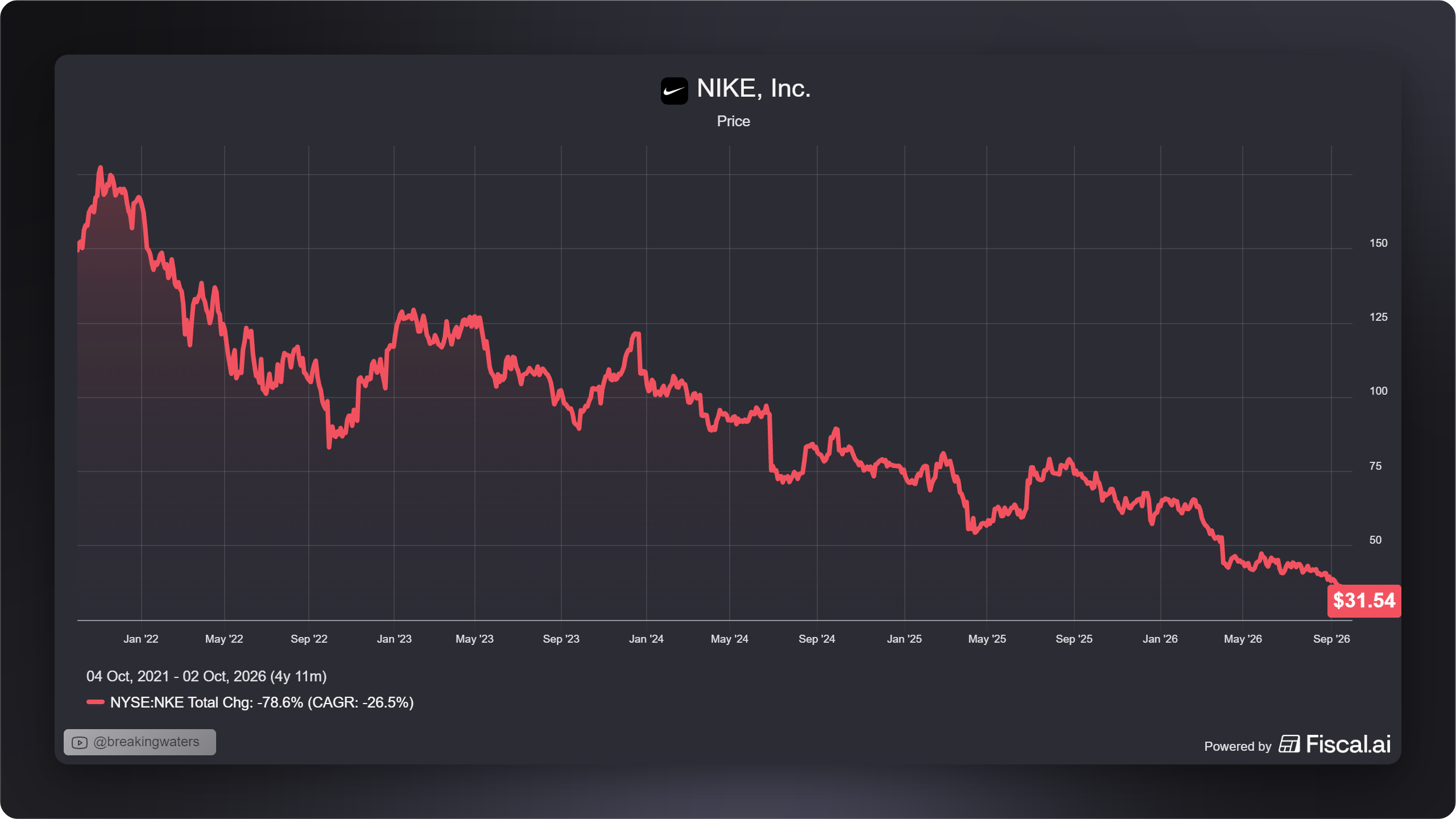
In my recent How The Wave Broke update, I mentioned that NKE 0.00%↑ Nike and the Nike stock price has had about as bad a 5 years as you can have, as demonstrated by this chart:
Several people reached out to me wanting more of my thoughts on the company and I too was wondering if the decline had run too far given the size of the fall. So below is are my thoughts.
NIKE - the Origin story
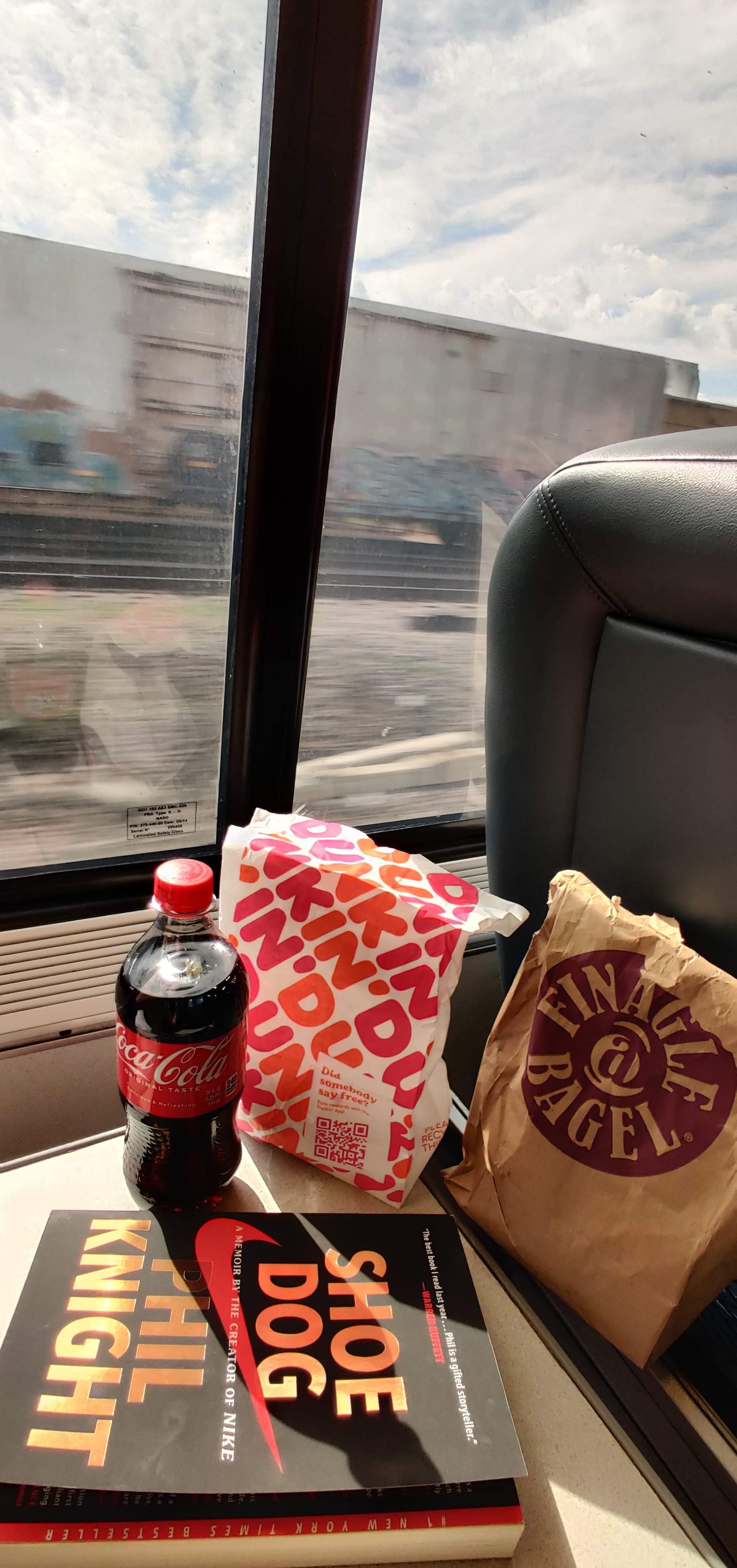
The story of Nike is one of the great American business stories and Phil Knight’s book, Shoe Dog is a must read for investors and entrepreneurs. Several years ago, I enjoyed it, along with other quintessential americana, on a train I took from Portland, ME through Boston and on to New Haven, CT.
Knight was a student at Stanford University as well as an avid runner with a quirky, experimentative, innovative coach, Bill Bowerman. While at Stanford, Knight wrote a paper for his entrepreneurship class proposing that cheap, high-quality Japanese running shoes could break the American market dominance of German brands like Adidas and Puma, just as Japanese cameras had done to German cameras. After graduating in 1962, Knight took a trip around the world. Knowing that Japan was at the forefront of manufacturing, he traveled to Kobe, Japan, specifically looking to explore his thesis. While in Kobe, he found shoes made by Onitsuka Co. under the “Tiger” brand. Impressed by their quality and low cost, he cold-called the company requesting a meeting.

He had no business, little money and no experience. He was bluffing but, it so happened, that the Japanese shoe company were keen to explore opportunities in the US so they took him on face value and invited him to talk.
Knight met with Onitsuka executives in their boardroom. Pretty quickly, the executives asked which company he represented, and Knight realized he didn’t actually have one. Thinking on his feet, he recalled the blue track-and-field ribbons given to winning athletes and gave birth to a company, telling them he represented “Blue Ribbon Sports”.
He pitched them his thesis and incredibly, he secured the distribution rights for Onitsuka in the US. He ordered a few samples, and with his former track coach, Bill Bowerman, they went into business. In their first year, they went to race meets and they sold 1,300 pairs out of the trunk of Knight’s car, grossing $8,000. It continued to grow and they needed working capital. Domestic lenders were not supportive of their plans so, on the advice of their Japanese partners they turned to Japanese trading houses. Known locally as sogo shosha (総合商社), they are massive, highly diversified conglomerate companies that trade in a vast array of products and materials globally. They originally acted as simple middlemen to import raw materials into resource-poor Japan and export finished goods, they evolved into complex global investment and lending firms.
FROM THE FLAMES OF BLUE RIBBON
With their working capital secure and demand high, all goes well for several years until growing pains arise and Blue Ribbon and their Japanese partners part ways. Blue Ribbon rebrand to Nike, the Greek Goddess of Victory. In the rebrand they commission a graphic design student, Carolyn Davidson, $35 to design a logo for the new brand. Davis creates one of the most, if not THE most, iconic logos in history, the NIKE Swoosh.

Although she only billed Phil Knight $35 for the Swoosh design in 1971, Davidson received a massive surprise twelve years later. In 1983, Knight and Nike executives held a surprise party in her honour to formally recognize her contribution to the brand’s explosion and present her with two gifts:
A custom gold ring cast in the shape of the Swoosh, embedded with a diamond.
500 shares of Nike stock.
Through decades of aggressive stock splits and company growth, that original 500-share gift grew to be worth many millions of dollars, assuming she didn’t sell.
The new company has an immediate and existential problem though - Onitsuka is gone and they no longer have product, cool innovative product that people want. They look inward for inspiration and Bill Bowerman the running coach exec raises the idea of developing a concept he’d been dreaming of for a better running shoe, the moon shoe. He creates a prototype of his vision by pouring rubber into his wife’s waffle iron, with the aim of creating a lightweight sole with superior traction. The resulting “Moon Shoe” and subsequent Waffle Trainer become the company’s first major proprietary bestsellers.
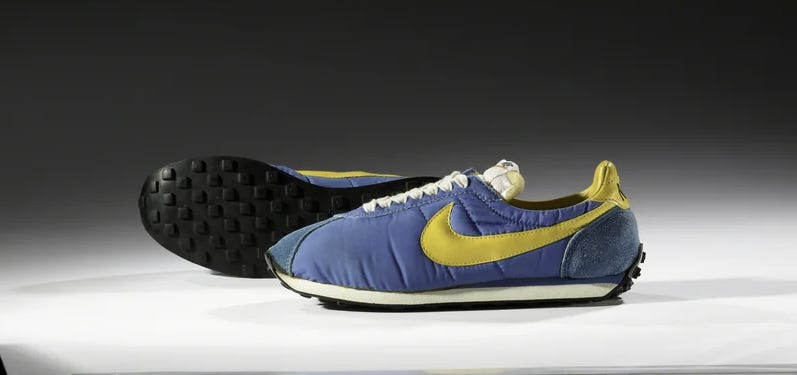
Source: Artsy / Nike, Waffle Trainer (1974) | Artsy
This recipe of obsessed and slightly crackpotty runners innovating in their kitchen with waffle irons is central to Nike’s success and is something that has been lost in recent years.
THE 70’s - THEY CALL IT YOGGING
The company rides this wave of innovating on their own proprietary designs for a decade but it had built its empire entirely on the 1970s running craze. By 1983, that boom had plateaued. The market for running shoes was saturated, and Nike, which was still viewed almost exclusively as a “track and field” company, saw its core sales stall. By early 1984, Nike reported its first-ever quarterly loss since going public. Inventory was piling up in warehouses, the stock price had plummeted, and Knight was forced to lay off roughly 400 employees (about 10% of the workforce). The company was facing another existential crisis and desperately needed a lifeline.
Here, again, Nike showed a spirit they lean into in such times. When the chips are down, they believe in themselves in a way they want you, the athlete wearing their gear to believe in yourself. They eat their own cooking so to speak.
Faced with extinction, they had one last play, $500k to spend on a non-running strategy. They decided on basketball but instead of spreading their $500,000 of endorsement across several solid NBA players (the standard industry practice), they decided to bet the entire budget on a single unproven rookie who could serve as the face of the brand. L
This is an insane move, a wild, crazy, completely audacious move.
We are of course talking about Michael Jordan but at the time, Jordan was earmarked for a good career but Nike was essentially betting its entire budget, and maybe its existence, on a rookie guard in a league ruled by towering centers and established veteran superstars like Magic Johnson and Larry Bird. It was a massive gamble.
Source: Air. Directed by Ben Affleck, Amazon MGM Studios / Warner Bros. Pictures, 2023.
The release of the Air Jordan 1 in 1985 revolutionised sports marketing and sneaker culture, turning a performance shoe into a billion-dollar lifestyle sub-brand.
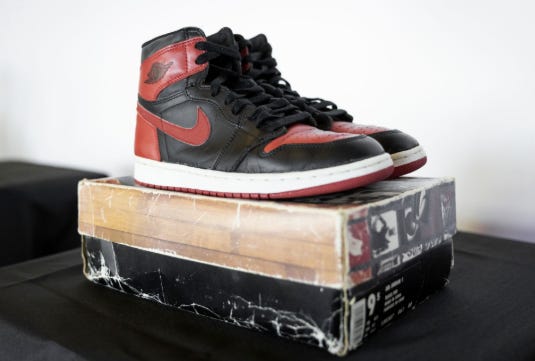
When Jordan stepped out in his new black and red Nike basketball shoes, the NBA banned them because they violated the league’s strict uniform policy, known informally at the time as the “51% rule.” All players’ shoes had to be at least 51% white and must match both the team’s uniform colours and the shoes worn by their teammates. Jordan’s striking black and red shoes blatantly ignored this standard, leading the league to issue a formal letter to Nike threatening to fine Jordan $5,000 for every game he wore them.
Instead of backing down or pulling the shoe, Nike recognized the opportunity and turned the penalty into one of the most successful marketing campaigns in history. Nike executives gladly offered to pay the $5,000 per game fines so Jordan could keep wearing the shoes on the court. They saw that the media coverage was worth far more than the penalty. The ban gave the sneakers an instant anti-establishment appeal. Teenagers and fans rushed to buy the shoes the NBA deemed “illegal,” transforming the Air Jordan 1 from a performance athletic shoe into a must-have cultural status symbol.
Today, the Jordan Brand generates approximately $7 billion in annual revenue for Nike. Michael Jordan receives 5%, forever, which is why you always see his name in the top 10 best paid athletes list every year.
THE JORDAN PLAYBOOK
On the back of this momentum, their new found cultural cache and their escape from being just an athletics brand, Nike began to grow and in 1988 they launched their Just Do It tagline. The 90’s and noughties were a time of win after win after win in marketing and culture. Their signing of Tiger Woods for example, had a reception from the golf establishment and traditionalists that was largely hostile, sceptical, and marked by a culture clash but Woods’ dominance put them again atop the pedestal as the brand of champions.
Remember this:
Source: The Masters | Tiger Woods’ Chip on 16 | Iconic Masters Moments
Priceless marketing with the swoosh front and center.
In the 2010’s the company moved to a dominant position, becoming the exclusive uniform provider for the NFL in 2012 and the NBA in 2017. Its SNKRS app became a major hit too, driving direct-to-consumer sales and creating manufactured scarcity for limited releases.
THE COVID-19 PANDEMIC
But then the pandemic came.
With people locked at home with little to do and in the US, with support cheques now in their pockets, the second-hand market for sneakers exploded. This was also happening in watches, trading cards and vintage apparel. This was happening at the same time retail traffic and revenues dried up due to lockdowns. Nike though, made the mistake of thinking this was the new status quo. They explicitly detailed this strategy in 2020/21, branding it as the “Consumer Direct Acceleration” (CDA). In their earnings calls and 2021 Annual Report, Nike explicitly stated they were actively reducing their reliance on what they termed “undifferentiated wholesale accounts” - corporate phrasing for independent sneaker shops and mid-tier retail chains that Nike felt didn’t offer a premium or unique presentation of their products. At the time Nike Direct accounted for c.39% of revenues which grew to 42.3% by Q3 2022 and Nike execs announced a target of 60% but once retail shops were reopened, demand returned to retail stores but now the relationships had been severely damaged. Nike had openly declared to retail footwear and apparel stores - tough businesses to make money on at the best of times - that they were no longer important or needed. Decades of partnerships cast aside almost on a whim. That includes specialty running stores, where Nike’s core, OG, customers - runners - go to talk to experts about the everything running, but especially the shoes. Nike had severed their connection to their original and spiritual partner, runners.
As this was happening, a host of high quality operators who had been waiting in the wings seized the opportunity. Hoka, ON and Brooks. They courted retail operators, especially specialty running shops, lavishing them with time, attention, enthusiasm, inventory and innovative new products that excite consumers. They took the shelve space and Nike will have to do something special to get it back. They need to innovate, rebuild retail TLC and tap into the spirit that got them there again.
WIN NOW, BUT WAIT, PACE IT
So what have they been doing about it?
Nike has initiated a multi-year turnaround effort, catalysed in late 2024 with the replacement of CEO John Donahoe with Nike veteran Elliott Hill, brought out of retirement for the role.
Hill is a Nike veteran who climbed from a 1988 internship to oversee its global operations before retiring in 2020. This was relatively short lived however, as he was brought out of retirement in 2024 to become President and CEO to lead the turnaround effort.
Hill began with an initial “Win Now” strategy, which focused on returning to their core approach, rebuilding retail partnerships, focusing back on performance athletics over lifestyle sneakers and reducing the supply of classic retro shoes. While the “Win Now” plan successfully cleared out billions in stale inventory and stabilized the running category, the broader product turnaround has taken longer than expected, leading Hill to introduce the more drastic, long-term “Pace” restructuring plan only in the last few days.
The more aggressive “Pace” restructuring plan focuses on:
Pivoting Back to Wholesale: Reversing a costly over-reliance on Direct-to-Consumer (DTC) digital sales. Hill is actively repairing relationships with wholesale retail partners (like Foot Locker and Dick’s Sporting Goods) to reclaim physical shelf space ceded to competitors.
Sport-Specific Restructuring: Nike reorganized its internal product teams back into sport-specific categories (e.g., running, basketball, soccer) rather than broad demographics (men’s, women’s, kids). This aims to speed up product innovation and tailor footwear more closely to athletes’ actual performance needs. Conway’s Law comes to mind.
The “Pace” Cost-Cutting Plan: targeting roughly $2.5 billion in savings. This includes geographic restructuring and a fresh round of job cuts to streamline operating overhead amid continued weakness in Greater China and its legacy Jordan brand.
Pricing Power & Inventory Cleanup: To protect brand equity, Nike is actively clearing stale inventory and weaning its digital platforms off constant promotions. Concurrently, the company has implemented targeted price hikes across core footwear and apparel categories to offset rising supply chain costs and tariffs.
New Retail Partnerships: To capture under-penetrated consumer segments, Nike has begun introducing new wholesale partnerships, such as placing inventory with the popular women’s fashion retailer Aritzia.
WHERE WE STAND
Nike reported fiscal Q1 2027 revenue of $11.21 billion, below the $11.32 billion consensus, while EPS of $0.48 topped the $0.44 estimate.
The company is expanding its restructuring, targeting $2.5 billion in savings through fiscal 2031, and forecast a high-single-digit revenue decline for fiscal 2027.
As they say though, nobody ever cut their way to growth.
Weakness in China and other markets is driving further changes, including planned job cuts, a three-region operating model and removal of online sales rights from some large Chinese retail partners.
Analyst views shifted lower overall, with several firms cutting price targets and BofA Securities and Berenberg downgrading. DA Davidson upgraded the stock to Buy despite lowering its target.
Nike Brand revenue was $10.95 billion and Converse revenue was $263 million, both below consensus estimates. Management cited continued pressure in China and EMEA, as well as challenges in sportswear and the Jordan brand; CEO Elliott Hill said restoring performance in key segments will take time as Nike rebalances its product portfolio.
Analyst actions were mixed but predominantly cautious.
Other developments included a $200 million, 10-year apparel partnership with the University of Miami and the appointment of Alexandre Arnault to Nike’s board. Converse, Nike’s wholly owned subsidiary, apologized for and removed an advertisement after public criticism; soccer player Kylian Mbappé also ended his Nike partnership and joined On as a global ambassador.
THE BULLS AND BEARS
The bull and bear scenarios for Nike’s stock, hinge on the company’s ability to execute innovation, rebuild its retail partnerships and navigate macroeconomic pressures, especially China.
The Bull Case
The upside potential of NKE 0.00%↑ relies predominantly on it rebuilding its relationships with 15,000 retailers in the US and a turnaround in its China business.
The Bear Case
The downside case is basically an inability to deliver on the bull case targets while also seeing market share continuing to be eaten by newer brands.
For me, NKE 0.00%↑ is straddling two equally likely futures, where the upside potential doesn’t pay for the risk of the downside. Although the price is down c.80% in five years, at this price I would need the business to have some truly attractive, and more likely an upside, or I would need the price to be much more compelling, i.e. in deep value territory. One to keep watching.
Some insightful pieces on Nike I came across in writing this:
Evan Sohn of Revelio, Nike’s Next Layoffs Haven’t Started. Its Headcount Is Already Down 8,843.