


In the news over the last week, the headlines out of France have painted a distinctly chaotic picture. Significant political unrest, looting, protests spilling into the streets, and a general sense of domestic gridlock have dominated the front pages.
If you were a tourist, you might cancel your trip to Paris. Unless you’re these folks, and you’re not bothered:
If you were an investor with exposure to France, your instinct on seeing this unfold might be to sell it all. Yesterday, I ran a no-peeking poll of 120 investors to see what people thought the CAC 40 had done in the five days since the unrest kicked off. Here are the results:
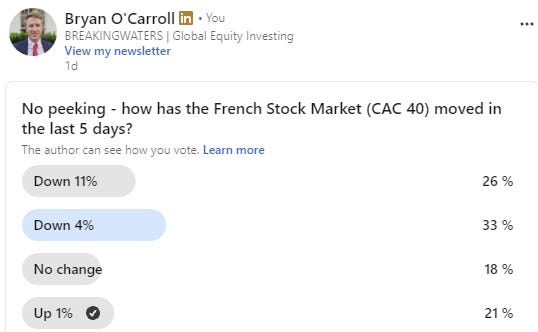
Nearly 80% thought it was flat to negative and nearly 60% thought it went down - both of which, to be fair, are reasonable responses. Observing how the market performed though, you might be scratching your head - when I launched this poll the index was up.
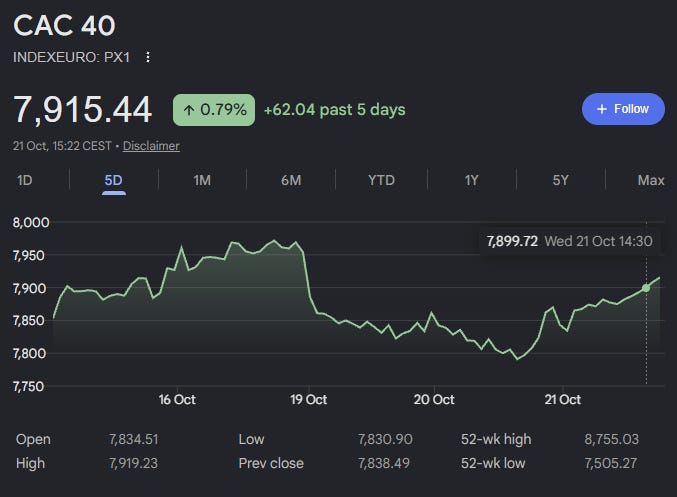
Despite the intense domestic turmoil, France’s benchmark stock index remained stubbornly resilient.
How does the stock market of a country experiencing acute political stress just shrug it off?
The answer lies in the DNA of the CAC 40 itself.
SUMMER IN FRANCE, WINTER ABROAD
The most crucial characteristic of the CAC 40 is that it is structurally disconnected from the French domestic economy; the companies that make up the index are overwhelmingly global.
Over two-thirds of their revenue and their workforce come from outside of France. When you buy the CAC 40, you aren’t exposed to the French consumer or the domestic political climate; you are buying a globally diversified portfolio of multinational titans that just happen to be headquartered in Paris. A strike in Marseille or a political stalemate in the National Assembly has virtually zero impact on whether a consumer in Shanghai buys a designer handbag or an airline in Dubai orders a new commercial jet.
TOP 15 COMPANIES - CAC 40 - c.80% of Index Weight
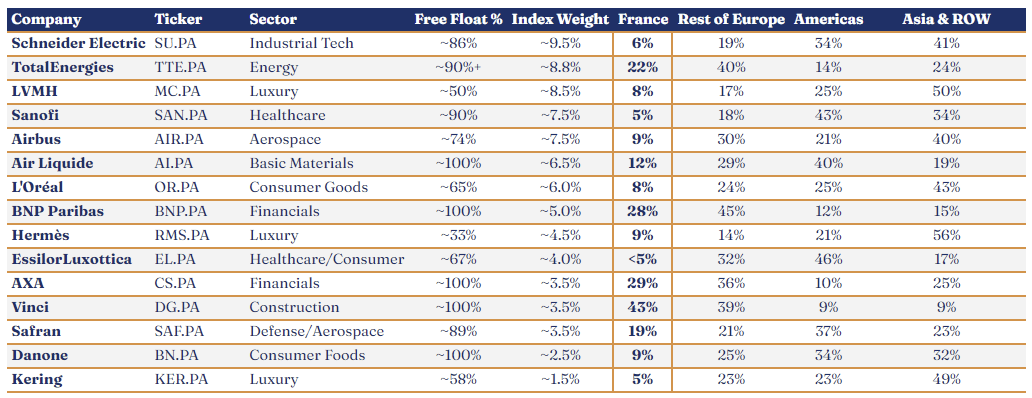
As an aside, you might also notice that LVMH is the third-largest company by weight in this table, even though it is often the most valuable company in Europe by total market cap.
The CAC 40 is weighted by free-float market capitalization. This means it only counts the shares available for the public. Because the Arnault family owns nearly half of LVMH, those insider shares are not included in the index calculation. The same applies to the Bettencourt family’s massive stake in L’Oréal, and the Hermès family’s ownership of Hermès. I have included a free float % column in the above table to indicate how much of the market cap is being valued.
Even with those insider shares stripped out, the luxury sector still commands a massive chunk of the index, all while making the vast majority of their money in the U.S. and Asia.

LUXURY, ENERGY and GLOBAL HEALTH
Because it rewards sheer global scale, the top of the index is dominated by sectors that are somewhat immune to local French politics:
Luxury Behemoths: LVMH, Hermès, Kering, and L’Oréal. These companies rely on the economic health of the U.S., China, and broader Asia, not the domestic French retail market.
Industrial and Defence Titans: Airbus (aerospace), Schneider Electric (global energy tech), and Safran (defence) are driven by global defence spending and international trade cycles.
Energy and Pharma: TotalEnergies and Sanofi are massive global players. TotalEnergies sells oil and gas worldwide, currently enjoying elevated prices, while Sanofi’s drug pipelines are focused heavily on the U.S. healthcare market.
While French domestic banks (like BNP Paribas or Société Générale) and local utilities might feel the squeeze of rising domestic bond yields or local regulatory fears during times of political stress, they simply do not carry enough weight in the index to drag it down.
EARNINGS VS POLITICS
Earnings results last week were generally good. The tone was set early in the week by LVMH, as mentioned in our recent How the Wave Broke. In spite of weakness in China, a major market of theirs, they came in with slight growth on revenues.
The momentum carried through the week with other multinational reports, including advertising heavyweight Publicis and spirits giant Pernod Ricard, while investors actively positioned for L’Oréal’s upcoming numbers. Energy giant TotalEnergies is also a major beneficiary of the unrest in the Middle East. EssilorLuxottica also beat estimates, aided by its smart glasses revenues.
CONCLUSION
Headlines do not always convey the stock market story. Look a little deeper and you might find that your portfolio is not nearly as exposed as you think.