


The following is not investment advice, it is for educational purposes only.
America is a wonderful country filled with lots of wonderful people, but it’s fair to say, Europe has been getting quite a bad rap of late from its closest ally in trade, defence, and most importantly, values.
Criticisms have been coming in for a while now, but they came thick and fast at Davos last week, and, if, like me, you watched a lot of the sessions live, you might have been taken aback by the level and litany of it all. It came from a variety of corners - and from both sides of the aisle - lambasting Europe for getting it all wrong - economics, tech, AI, immigration, defence, politics, and above all else, sustainability.
I have so many American family and friends, and it makes me sad to see this rhetoric coming from the CEO’s and politicians there.
I count myself very lucky to be European. Even luckier to have come of age at a time when interrailing was encouraged, and travelling to Paris, Barcelona, Berlin or some other amazing continental destination was cheaper than taking the train from Dublin to Galway. Tip of the hat to Michael O’Leary and Ryanair, who facilitated that for me. And I availed. I loved it, and I still love it. Europe is filled with amazing places. And people. I have known many Europeans, of many nations, through education, work, social circles, and travel, and I can only sing their praises.
EUROPE’S INVESTMENT CASE
But what of the investment landscape? Is Europe really so dysfunctional as it’s made out to be by our transatlantic friends? I don’t think so. It’s certainly not the complete basket case it is made out to be.
It’s true that in the last 10 years, US GDP growth has outstripped Europe by about 15%. Per Bloomberg data, there has been c.32% real GDP growth for the US vs c.17% for Europe. But, in funding this growth, the US has been borrowing heavily. The debt of the US has gone from 103% of GDP in 2015 to c.124% in 2025. And GDP, remember, is a growing number itself.
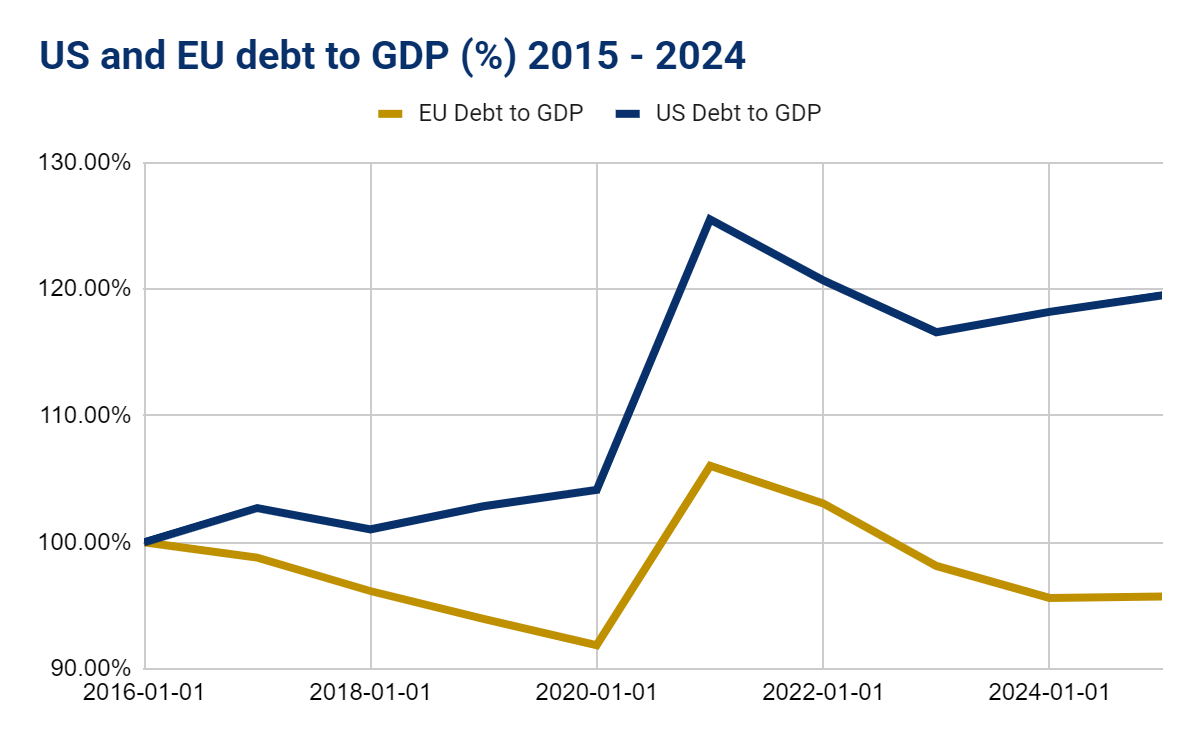
source: Bloomberg Finance L.P., 29 Jan 26. Data to 31/12/2024.
In other words, every dollar of growth has cost more than one dollar to obtain. Europe, meanwhile, has seen debt, as a % of GDP, fall from 91% in 2015 to 87% in 2025. Growth has been delivered while reducing debt and these figures include the pandemic borrowing spikes. So yes, Europe has lagged on productivity, but it has been materially more fiscally responsible. This puts it on much firmer ground for the next few years, where investment in AI, energy, housing, and infrastructure is expected to be high.
Next, inflation. Europe is enjoying lower inflation at 1.9% as of December. Inflation that is also declining - in part due to deflationary effects from US tariffs redirecting China exports, while the US is seeing the rate of inflation remain elevated at 2.7%, with concerns it could creep upwards. Europe, as a result, is on better ground here too.
The debt load and inflation profile of Europe make the region relatively more attractive for investors, particularly bondholders. This is borne out at the time of writing, where the 10-year yield on European Bonds (3.18%) is c.1% lower than US 10-year bonds (4.25%).
Now place these items alongside the “bubble” concerns around US stocks and AI names. Concerns that put an additional downward vulnerability on US stocks. By contrast, valuations are not challenging in Europe, and many of their key industries, such as luxury, healthcare, German exporters, financials, and autos, remain notably subdued and out of favour compared to history- usually a good place to start if you’re looking for upside.
So, looking at it through these lens’, Europe is well placed as a standalone region for investment opportunity or equally, as an alternative to US exposure that should benefit from any cracks that appear in US equity sentiment. We had a glimpse of this in 2025 when some were calling the end of US exceptionalism. Europe benefited greatly. Many have already forgotten that the Euro Stoxx 50 outperformed the S&P 500 in 2025, while also trading at a notable discount.
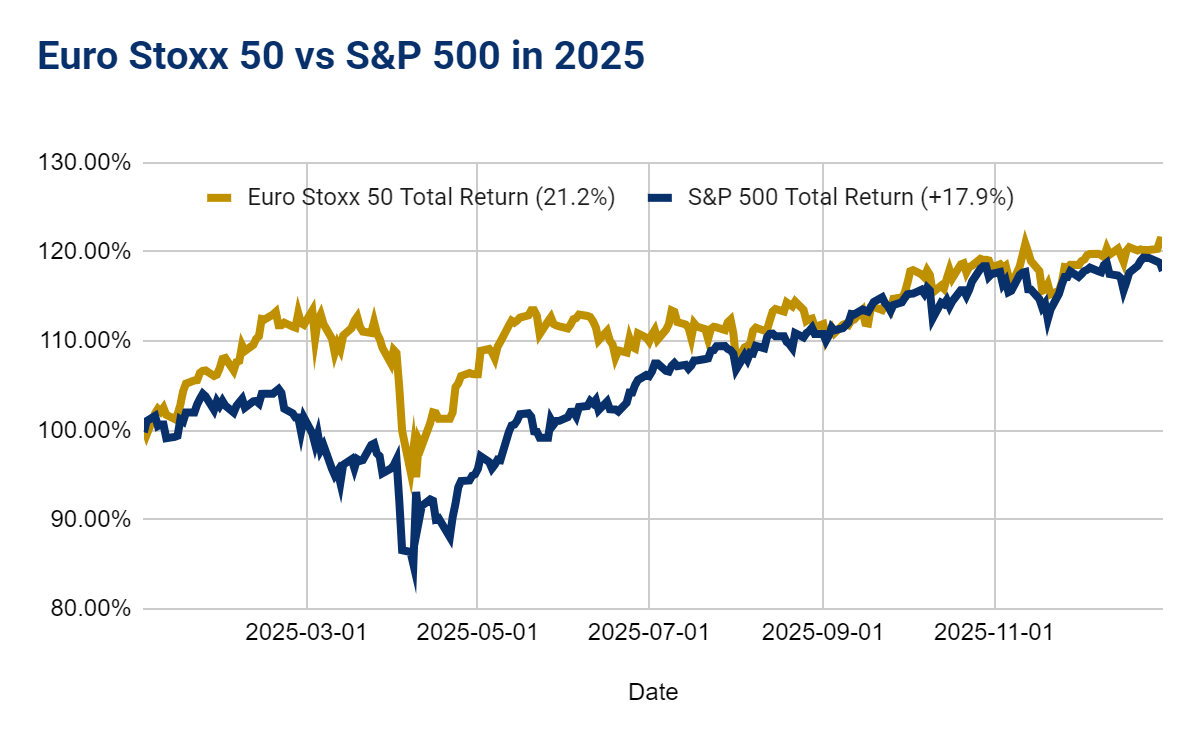
source: Bloomberg Finance L.P., 29 Jan 26. Data from 31/12/2025 to 31/12/2025. Past performance is not an indicator of future performance.
ONE MAN’S TRASH
And finally, let’s not forget the old adage: one man’s trash is another man’s treasure.
Productivity is extremely important, but it’s not the only stick (metre, yard, or otherwise) to measure success by.
Europe came under its harshest criticism at Davos for its support of sustainability. Purchasing solar panels was stupid. Building wind farms was a loser and thus, for losers. But, Europe thinks differently, and I am delighted and proud that they do. Not only is it the right thing to do as citizens of the planet, it is also the tactically correct approach. It reduces reliance on external energy sources and improves the region’s strategic footing into the future. More wind energy, please!
Sure, Europe has not been as productive over the last 10 years (but when debt is accounted for, the story changes), but stepping beyond the economics, what is the goal here, as people, as families, as communities, as societies? Happiness right?
A complex term in and of itself, but one that encapsulates a lot of factors that matter in the geopolitical sphere. On this measure, Europe stands out with no less than 14 European countries in the top 20 of the World Happiness Report. The US comes in at 23. It turns out that productivity-at-all-costs has a cost, and that cost is happiness somewhere along the line.
Before 2020, many would have believed that events from COVID to the invasion of Ukraine to now, the Greenland tension would have shaken the seemingly slow, weak, disjoint European system into pieces. On the contrary, the region has risen to every challenge at speed, unified, and is a much stronger version of itself now than it was 10 years ago.
LOOKING TO THE FUTURE
Looking out from where we stand today, I am very confident in my Europe. I see many healthy and attractive investment opportunities. I look forward to flying over fields of European wind farms on innovative European budget airlines, on my way to new and exciting destinations. But, above all, I can’t wait to connect with many new, wonderful, stupid European losers, like myself.