

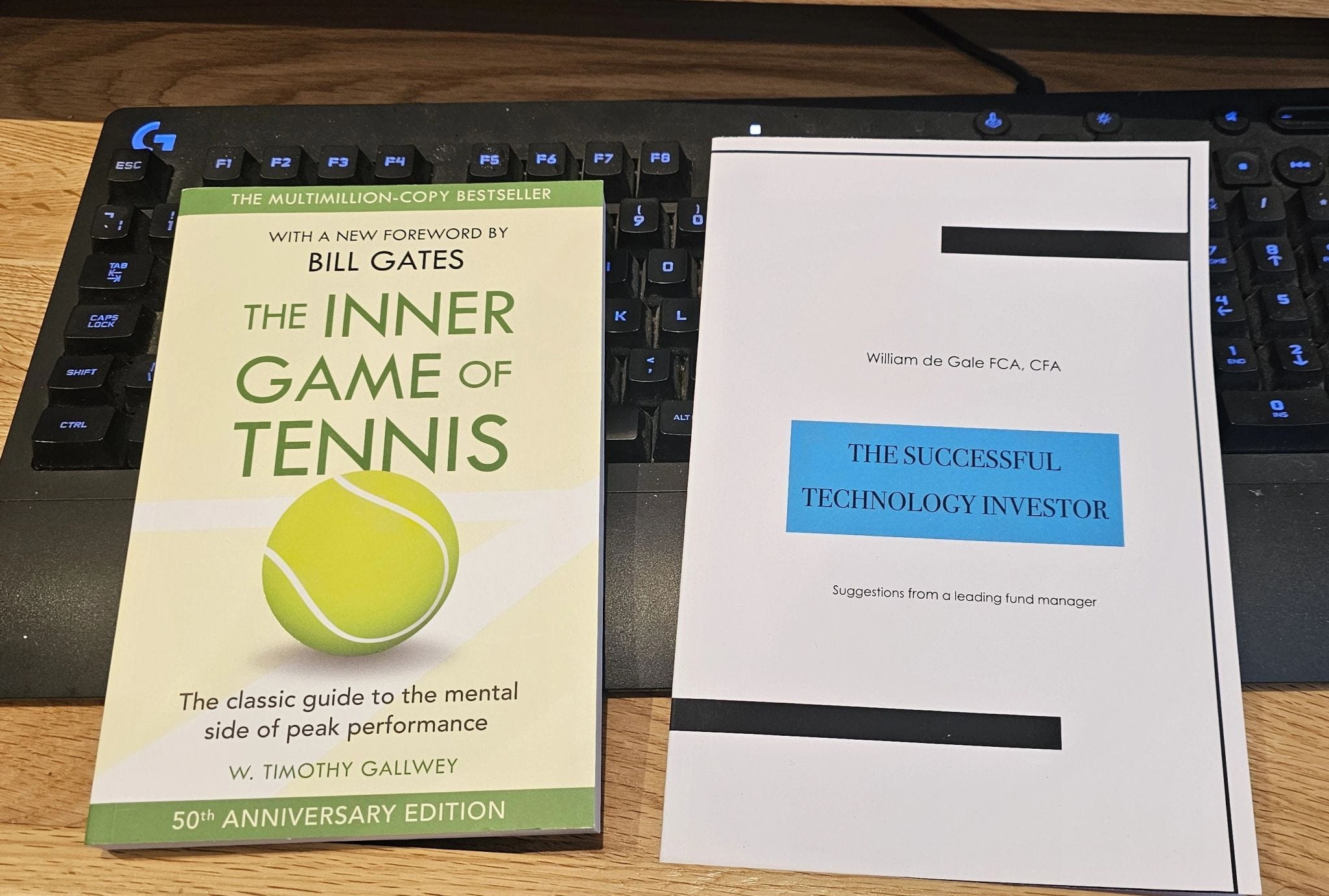
In 1974, a tennis coach named W. Timothy Gallwey discovered something that had nothing to do with backhands and everything to do with how the human mind sabotages success.
The event that got him thinking was an interesting one.
Gallwey’s philosophy wasn’t born in a lab; it was born on the court with a client named Jack.
Jack had a “terrible” backhand. He knew exactly why: his backswing was too high. He had already seen five different pros who told him the same thing. He had the knowledge, he had the desire, and he had the “Self 1” instructions on a loop in his brain. Yet, every time the ball flew toward him, his hand spiked upward.
Gallwey realized that if five pros had failed to fix it with words, a sixth pro offering more words was useless. Instruction was the problem, not the solution.
So, Gallwey tried something radical: he stopped talking.
He led Jack to a glass window and asked him to watch his own reflection while he swung. No critiques, no “shoulds,” just observation. Jack swung, stopped, and looked at the glass in total shock.
“Hey! I really do lift my hand too high!”
It was a staggering moment. Jack had “known” the flaw for years, but he had never observed it without judgment. Once he actually saw the reality - rather than hearing a lecture about it - the correction happened almost instantly. He adjusted his swing to feel “right” in his body, and the habit stuck.
Jack thanked Gallwey for “teaching” him more in twenty minutes than others had in months. But Gallwey realized he hadn’t taught Jack anything. He had simply removed the noise of Self 1, allowing Jack’s Self 2 to see the truth and fix itself.
But who are Self 1 and Self 2?
Self 1 (the "teller") - the conscious, analytical, and often judgmental ego-mind. It is the voice in your head that provides constant instruction, criticism, and evaluation. Its primary traits include: judging every shot as good or bad (“keep your wrist firm, you idiot!”), trying to control every muscle movement through verbal instruction i.e., telling, is best which brings tension to the body, inhibiting peak performance, and it dwells on the mistakes gone by, pulling focus away from the present moment.
Self 2 (the “doer”) - on the other hand, doesn't "think" in words; it operates through images, feelings, and instincts. It is the part of you that caught a ball when you were a child before you knew the laws of physics, and it’s the part that manages the thousands of complex muscle firings required just to stand upright. Self 2 understands imagery over being told, exists in the now, and ultimately lets success happen rather than makes it happen.

In the Inner Game philosophy, the objective isn’t to “make” yourself play well, but to “let” yourself play well. This requires a fundamental shift in trust. You have to trust that Self 2 knows how to hit a tennis ball better than that Self 1 knows how to explain it.
Self 1 can support Self 2, though, by shifting from a critic to a quiet observer. Instead of micro-managing mechanics with verbal “shoulds,” Self 1 can provide a clear visual goal - an image of the desired shot - and then trust the body to execute.

The Inner Game of Tennis was first published in 1974, 52 years ago (yes, that’s right, I’m afraid), but the concepts it presented were revolutionary, and it remains a classic that speaks to so many walks of life. It has elements from ideologies such as the hippy movement, taoism and Stoicism woven through it, but it is presented through a tennis lens, infused with a modern Western drive for continuous improvement.”
For investing, parallels can be drawn with many of the concepts. 3 clear parallels are:
Being present - We talk about trusting the process and not focusing on particular investment outcomes within a portfolio, which is akin to the idea of being present. You must always be present in investing, every day the board resets, yesterday’s unattractive opportunities may have tipped into attractive territory as a result of market twists and turns and vice versa.
Be objective - no self-criticism and no berating oneself for getting things wrong. As in tennis (as laid out by Roger Federer recently), investing is a game of margins, not illusory perfection or dominance. Winning by small margins consistently compounds to outsized outcomes. Use self 1 constructively to support self 2.
Adaptation - is a core concept of the Inner Game of Tennis, as it is with investing thinking. Gallwey argues that habits aren’t changed by fighting them, but by superseding them. He compares habits to a garden: You don’t “fight” a weed to get rid of it. You simply plant a different seed (a new habit) and give it more water and attention than the weed. Eventually, the new plant grows, and the weed withers away naturally. So find the weeds in your thinking and plant new and better seeds.
The Inner Game of Tennis will give you pause for reflection on how you can approach your world. It offers ways of looking at problems from an angle that is frankly much more fun and interesting than berating yourself. Get out there and don’t make yourself perform; let yourself perform!