


Image AI edited. Original by A. Brothers. Jevons Family Papers, University of Manchester Libraries.
This week has seen two AI fear-mongering pieces go viral.
Matt Shumers, “Something Big is Happening” and Citrini and Alap Shah’s “The 2028 Global Intelligence Crisis”.
These were the spark to the tinder of sentiment on AI, and they triggered large moves in software stocks and generated a multitude of headlines:
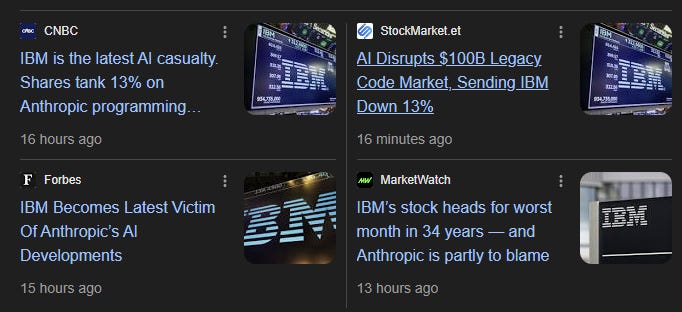

But there are a few elements of this story to look at before we think about what it really means. In short, I am sceptical of the AI the Destroyer idea and here’s why:
HOW QUICKLY WE FORGET
Firstly, let me take you back, all the way to 2025.
On January 20, 2025, the DeepSeek-R1 reasoning model was launched. Deepseek, a side project of a Chinese quant fund, delivered a model that, compared to the hyperscaler juggernauts, was materially more efficient, using less compute, costing much less, and yet, its output was on par with the best on offer in the West. It caused a flurry among AI investors and across the markets. The hyperscaler story on which so many portfolios were stacked was completely blindsided by a cheaper, more efficient, innovative Chinese model. A shot straight across the bows.
The scramble was on to understand what this meant and if the exuberance driving markets had been overdone. Some argued it was the death knell sounding for the AI investment dream. Some said it was a sputnik moment and how, on wings of hubris and limitless capex, and the wind of national pride, hyperscalers would reach higher highs than ever. Others were still waiting for their copy of the Innovator’s Dilemma to arrive.
Cometh the hour, cometh the man.
Satya Nadella stepped into the fray and delivered what became the quieting salve for all involved, with a brief but erudite tweet:
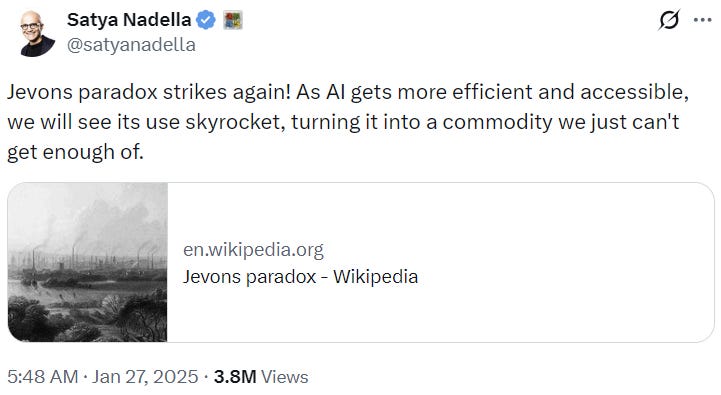
“Jevons paradox strikes again!”
Brilliant. A masterclass in leadership and pr. A definitive position, highlighted in four words, but also, crucially, retaining his position as the expert and us as lowly wonderers, because who had ever heard of Jevons Paradox? Confident of our lack of understanding, he includes a link for us to educate ourselves and save our blushes when we speak so confidently on the subject in the next client meeting. That’s the power of a great CEO - hyperscalers, investors, political leaders, finance bros, and so many more could breathe again.
JEVON’S PARADOX
Jevon’s paradox was put forward by William Stanley Jevons in 1865. At the time, there was widespread concern in the UK that the coal fueling the industrial revolution and bringing huge economic opportunity would run out. The salve of that day arose and proposed that continued improvements in coal-burning efficiency would reduce reliance on coal. Output - fixed in this theory - could be maintained with less coal. Jevons wasn’t sold, however, and in his book, The Coal Question: An Inquiry Concerning the Progress of the Nation, and the Probable Exhaustion of Our Coal Mines (available here), he outlined a response.
Jevons argued, and Satya reminded us 159 years later, that as technologies become more efficient, they tend to lower the barrier to use, opening more use cases, driving more use, not less.
Back in 2025, hallelujah, the hyperscaler AI thesis was not only saved from the jaws of the dragon, but lo and behold, it would actually be even stronger as a result.
SAASPOCALYPSE
One year on, AI is now being proclaimed as the beast that will eat the beast that was going to eat the world.
Per below, software is down nearly 30% since the September highs. Almost a year to the day since the Deepseek moment, on January 26th, it took a 15% step down as fears rose that firms would replace their enterprise software partners with AI-powered, internally built solutions.
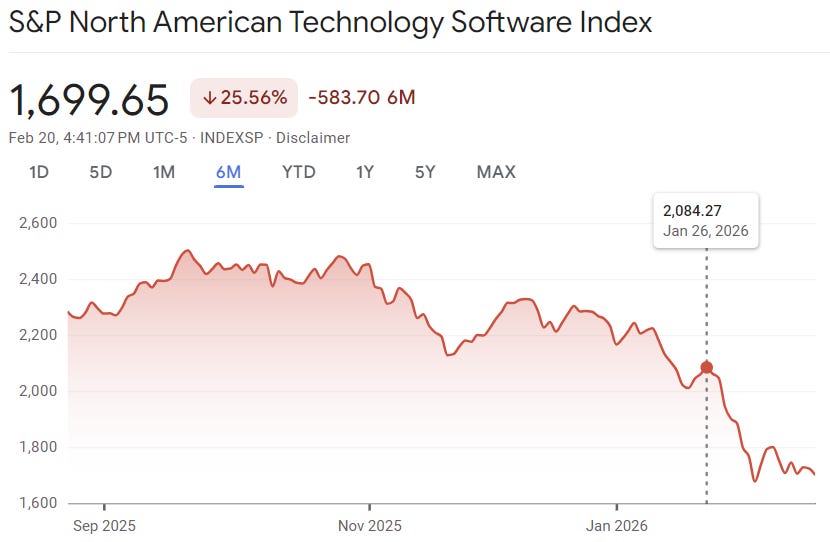
As William De Gale pointed out, though, in our recent Expert-in-Conversation session, earnings estimates are expected to rise for software firms for the next two years, a peculiar divergence indeed. N.B. Always good ground to explore investment ideas.
Interestingly, searches for Jevon’s paradox did not enjoy the same attention this time around.
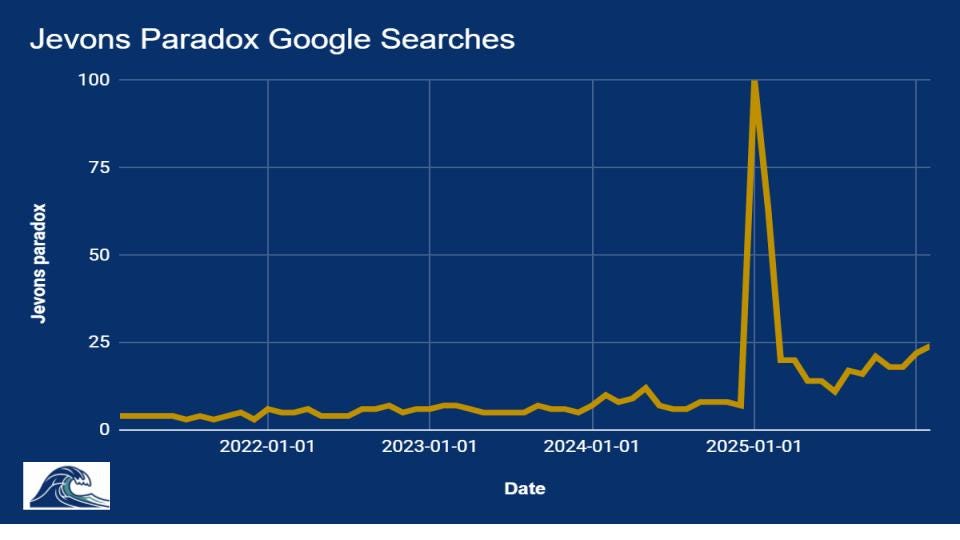
Maybe everyone knows about it now and takes it as accepted. More likely, it has already been forgotten. Satya didn’t tweet this time to save us from ourselves, and fear grew quickly in people’s minds. Sell first, read Victorian books about the coal economy later.
DEEPSEEK R-1 IN DISGUISE
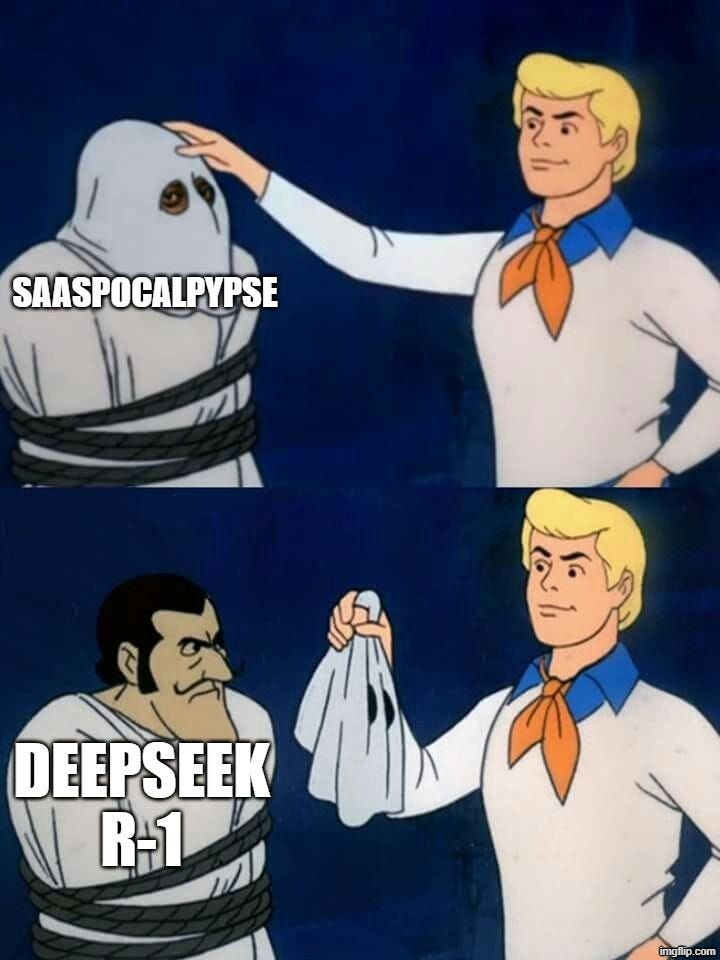
For many reasons, I am sceptical that AI will eat software whole (while also gutting jobs).
First, as William De Gale also pointed out in our Expert-in-Conversation session, software companies own the customer relationships, the data, the understanding of what is needed, and why things are the way they are for each customer. This matters.
Second, these companies have read The Innovator’s Dilemma and will be deploying AI across their businesses (if they have any sense). They will be doing this faster than their customers can build from scratch, test, and deploy a replacement. By the time it is replaced, the SaaS companies are even farther ahead.
“They will copy, acquire, or destroy to protect their business.” - William De Gale
Third, executives won’t move all their software development in-house. The potential benefits are far outweighed by the immense career risks and bureaucratic hurdles:
Career Risk: Tweaking existing, working systems is a better bet than risking their reputations on massive overhauls that might fail.
Bureaucratic Nightmares: Getting a large-scale shift approved and delivered requires exhausting amounts of overtime, political navigation, presentations, and endless meetings. Accepting leading AI solutions from existing partners does not.
High Turnover: Internal IT projects take years. By the time they are supposed to launch, the original champions of the projects have usually moved on. Vision and committment is lost, causing momentum to falter, usually to an end.
Budget Instability: Because budgets are evaluated annually, long-term projects suffer from cuts and squeezed resources in lean years, but generally, when the good years return, the committee forgets they ever cut your budget - “looks like you have more than enough to us, make it work”.
Fear of Legacy Systems: Execs are highly reluctant to rip out old software and systems because, often, they’re not sure exactly what those systems do.
Software providers play these other vital roles with large organisations. They carry the risk for the company, they affect compromise among stakeholders, and they are specialists (as much as execs say they know more), and they can improve the ways of working because they see what others do.
BACK TO JEVON
In the developed world, before the Industrial Revolution, nearly 90% of people worked the land. Today, that number is between 1% and 2%. Most of the c.88% who have been displaced wouldn’t dream of going back.
It seems far more likely to me that AI, in aggregate, will enhance the offerings and capabilities of all participants in the economy, including software firms.
Take me for example, I cannot create songs, videos or photoshop and I would not have employed anyone to do so, but in almost no time at minimal cost, I can now do that.
Jevon’s Paradox by J-Vonz
From the original image, I got to the above in about 10 minutes of playing around. Pre-AI, I couldn’t even have explored it, and I wouldn’t have. I wouldn’t have engaged any professionals who put together music, edit images, or animate images. No economic activity would have occurred for J-Vonz without AI. The professional still has their place too, because if this type of output, sloppy as it is, looked like it might be worth investing in, then I would get a professional involved.
That is Jevons’ Paradox at work, and software is no different. If you’ve ever sat at your desk and wished someone could do the less enjoyable tasks you need to get done so you could explore those ideas you’ve had forever, then I’ve got great news for you: that’s what AI is. And, as it works its way through the economy, companies will reach the same conclusion. Instead of setting their future at the level they are at today, they will look to their list of ideas and get working on them, because that is our nature.
